Industry
Promotional Products
Promotional products are the one category where the date is the specification. An event or a campaign does not move, so the range is engineered backwards from it — which changes how you choose decoration, how you bundle suppliers, and when a blank plus local printing beats a factory-decorated order.
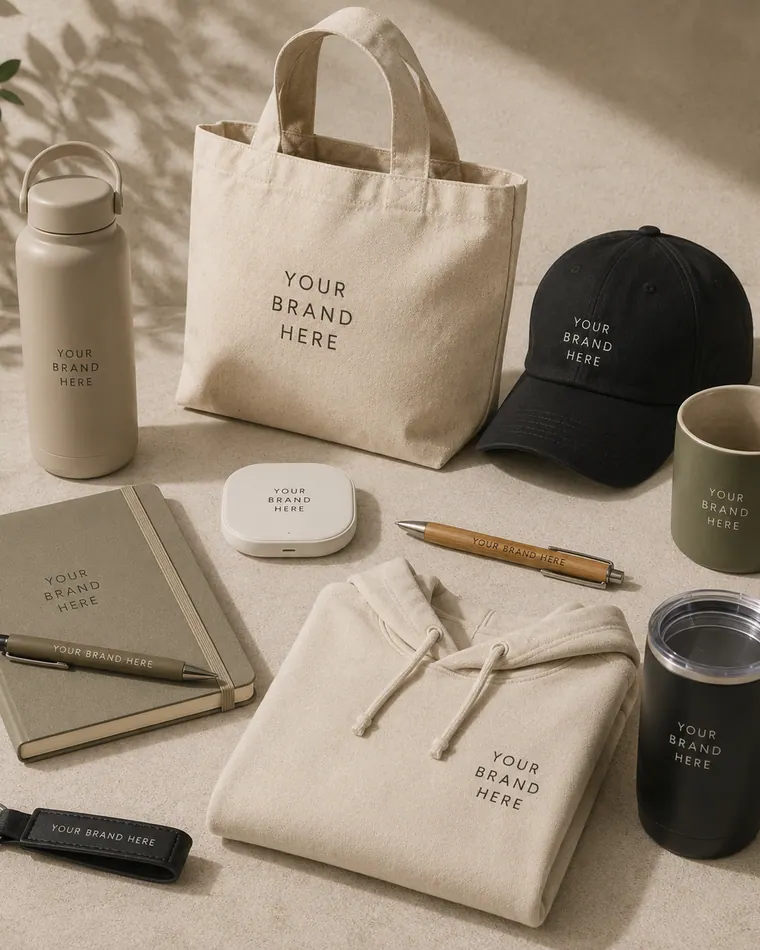
The date is fixed, so everything else is engineered around it
In every other category the delivery date is negotiated against cost and quality. Here it is given. A conference happens on its day, a campaign launches on its date, an onboarding kit is needed the week someone starts — so the schedule is the constraint and cost and sourcing route are the variables, which inverts the usual planning order. The practical consequence is that the decision to make is not "what is cheapest" but "what is the cheapest thing that arrives", and those are frequently different products.
The second peculiarity is that unit cost is dominated by setup rather than by material. Every decoration method carries its own setup — a screen, a pad, a plate, a laser file, an embroidery programme — and that cost is divided by however many pieces come off the run. So a mug at low quantity is mostly setup, and the same mug at high quantity is mostly mug. Each method also has its own colour fidelity and substrate limits: pad printing and laser work on hard goods, embroidery and screen printing on textiles, sublimation on polyester, and full-colour digital where a photographic image is needed. Choosing the method is choosing the price.
Third, this is a multi-SKU, low-quantity-per-SKU category, which makes the real work bundling rather than finding a factory. A single campaign can span apparel, drinkware, stationery and a tech accessory — four different manufacturing industries — with a few hundred pieces of each, all converging on one date. The lever that matters most is deciding which items come factory-decorated and which arrive as blank stock to be decorated closer to the market, because that single choice usually determines whether a fixed date is achievable at all.
And finally, colour. A brand colour on cotton, on anodised aluminium, on a powder-coated bottle and on a matte notebook cover produces four different results, because the substrate is part of the colour. A set that reads as one family needs an approved proof per item and per substrate, which is the discipline rushed orders skip and then regret in the photographs.
For teams whose merchandise has to land on a specific day
Situations we see here often, not an exhaustive list.
- Marketing teams sourcing campaign, event and conference merchandise
- HR and people teams building onboarding and employee gift kits
- Brands producing merchandise as a product line rather than a giveaway
- Agencies procuring branded items on behalf of client campaigns
- Retailers and ecommerce brands sourcing gift-with-purchase and loyalty items
What Library of Trade helps with
The points this category asks for most often, not everything we do.
-
Planned backwards from the date
The date is treated as the fixed input, and the sourcing route, decoration method and freight mode are chosen to meet it — including the honest answer when an item cannot arrive in time.
-
Decoration method priced properly
Screen, pad, laser, embroidery, sublimation, deboss and full-colour digital are compared per item on setup cost, colour fidelity and substrate limits at your actual quantity, rather than defaulting to whatever a supplier runs.
-
Multi-SKU bundling
A campaign spanning apparel, drinkware, stationery and tech is bundled across supplier types and converged on one delivery, so you manage one programme instead of six part-shipments.
-
Blank stock versus factory decoration
We compare a factory-decorated order against blank stock decorated closer to the market, because at a tight deadline that comparison is usually where the schedule is won or lost.
-
Colour managed per substrate
Approved proofs are set per item and per substrate so a set reads as one family, since the same brand colour reproduces differently on cotton, metal, coated plastic and paper.
-
Product safety still applies
A giveaway is a consumer product. Chemical restrictions and the general product safety framework apply, and anything powered or intended for children needs specialist assessment — see EU manufacturing compliance.
How Library of Trade sources this category
-
01
Brief
The event or campaign date, who receives the items, quantities per SKU, the budget per pack rather than per unit, the brand assets, and any sustainability requirements the programme has.
-
02
Product Development
Decoration method chosen per item, artwork adapted to each substrate and print area, brand colour targets set, and the kit or pack designed as a whole rather than item by item.
-
03
Materials
Substrates across a mixed range — cotton, recycled polyester, stainless steel, bamboo, aluminium, paper, moulded plastic — plus which items are available as blank stock and where.
-
04
Factory Matching
Bundling multi-SKU volumes across several supplier types against one date, and deciding item by item between factory decoration and blank stock decorated closer to the market.
-
05
Sampling
A pre-production decoration proof per item and per substrate, plus a kitted mock-up of the finished pack so the set is approved as a set rather than as eight separate approvals.
-
06
Production
Staggered production across suppliers with the longest-lead item setting the plan, and decoration scheduled so items land in time to be kitted rather than in time to be shipped.
-
07
Quality
Print registration and colour against the approved proof, decoration position and adhesion or rub resistance, kit completeness and pack presentation, plus product safety on the items themselves.
-
08
Logistics
One consolidated arrival where possible, with an air and sea split by criticality when the date is tight, then kitting, storage and distribution to the event, office or fulfilment centre.
Materials, processes and supplier types
A selection of what comes up in this category, not a complete list. If your material, process or supplier type is not here, name it in your brief.
Materials
- Cotton and organic cotton textiles
- Recycled polyester and RPET
- Stainless steel and aluminium
- Bamboo, cork and FSC-certified paper
- Recycled and bio-based plastics
- Powder-coated and anodised finishes
- Glass and ceramic drinkware
- Gift boxes, sleeves and tissue
Processes
- Screen and pad printing
- Embroidery and applique
- Laser engraving and etching
- Dye sublimation printing
- Full-colour digital printing
- Debossing and hot foil
- Doming and enamel filling
- Kitting and pack assembly
Supplier types
- Promotional manufacturer
- Drinkware and hard goods factory
- Apparel and textile decorator
- Stationery and print supplier
- European blank stockist
- Local decoration partner
- Gift packaging supplier
- Kitting and fulfilment partner
Quality, compliance and risk
The checks that apply here most often. What your product needs is decided per project.
Two things get judged here and both are unforgiving. The first is the decoration: position, colour against the approved proof, and whether the print survives handling — a logo that rubs off a bottle or cracks on a hoodie after one wash reflects on the brand that gave it away, not on the supplier. Adhesion and rub testing per substrate, and a proof approved on the actual item rather than on a screen, are what prevent that. The second is the pack: a kit missing one item is a failed delivery even when every item passed inspection, so kit completeness is checked as its own step.
Colour deserves its own line because it is the most common disappointment in merchandise. The same brand reference reproduces differently on cotton, on anodised metal, on powder coating and on uncoated paper, and no amount of insisting will make them identical. An approved proof per item and per substrate, agreed as the standard for that item, is what makes a set look coherent — and it also settles in advance the conversation that otherwise happens after delivery.
On compliance, the most commonly overlooked fact in the category: a promotional item is a consumer product and carries the same obligations as one sold at retail. Chemical restrictions under REACH apply to the materials, the EU general product safety framework applies, and anything containing a battery or electronics picks up electrical obligations and, for lithium cells, dangerous goods requirements for transport. Anything intended for or likely to be used by children falls into the far stricter children's regime and needs specialist assessment, which is why branded toys are not a casual line item. Food-contact items such as drinkware have their own material regime. Sustainability claims — recycled content, FSC, organic cotton — rest on voluntary schemes and need documentation to be repeatable.
- A decoration proof approved on the actual item and substrate, with position and size checked against it rather than by eye
- Adhesion and rub testing per decoration method and substrate before the run
- Kit completeness verified as its own inspection step for anything shipped as a set
- Product safety and chemical restrictions confirmed for each item, giveaway or not
- Battery-containing items treated as electrical products and as dangerous goods for transport
- Items for children routed to specialist assessment rather than sourced as ordinary merchandise
- Sustainability claims supported by documentation that survives being asked about
Sourcing regions
Regions that often come into play for this category. Not a ranking and not a complete list.
-
China
The widest promotional range at the lowest setup and unit costs, with deep decoration capability across almost every substrate, which is why most catalogue merchandise originates there. The constraint is sea transit, so it rewards programmes planned months ahead and punishes ones that are not.
-
European stock and decoration
Blank stock held in the Netherlands, Germany or Poland, decorated locally, is usually the fastest route to a fixed date and the reason a tight deadline is achievable at all. Unit costs are higher and the range narrower, but the schedule risk drops dramatically.
-
Turkey
Textile-led merchandise — bags, apparel, caps — at costs between Asia and Western Europe with days rather than weeks of transit. A sensible middle for a recurring programme with moderate volumes.
-
Vietnam
Strong sewn goods and textile merchandise with growing hard goods capability, and a useful alternative when volumes are large and the calendar allows sea freight.
-
India
Competitive on textiles, brass, leather-look goods and hand-finished items where labour content is high. Consistency and colour control across a run need closer specification and inspection, which is a planning cost rather than a reason to avoid the route.
Questions about this category
Our event is soon. What is the fastest way to get branded merchandise?
Usually European blank stock decorated locally, because it removes both the factory production time and the sea freight from the schedule. It costs more per unit and narrows the product choice, and it is often the only route that meets a fixed date. The honest first step is deciding which items must arrive and which can be dropped.
Why is the unit price so high on a small quantity?
Because decoration setup is paid once regardless of quantity. A screen, a pad, a laser file or an embroidery programme is the same cost for a hundred pieces as for ten thousand, so at low volumes the setup dominates. Reducing the number of colours, print positions or distinct items lowers the price faster than negotiating the item cost does.
Can you match our brand colour exactly on every item?
Not identically, because the substrate is part of the colour: the same reference reproduces differently on cotton, anodised metal, powder coating and uncoated paper. What is achievable is an approved proof per item, agreed as that item's standard.
Do promotional products need to meet product safety rules?
Yes. A giveaway is a consumer product, so chemical restrictions and the general product safety framework apply just as they would at retail. Powered items pick up electrical and battery transport requirements, drinkware has food-contact obligations, and anything for children falls into a much stricter regime that needs specialist assessment.
Can you source sustainable merchandise?
Recycled, organic, FSC-certified and bio-based options exist across most of the category. The important part is that these claims rest on voluntary certification schemes and need documentation traced through the chain, so the useful question is not whether an item can be called sustainable but what evidence will exist when someone asks.
Can you kit and distribute the items for us?
Kitting, packing and distribution to an event, an office or a fulfilment centre are coordinated as part of the logistics stage, including the packaging the set is presented in. A kit missing one component is a failed delivery, so completeness is checked as its own step before anything ships.
Related reading
Related industries
Bring us the brief. We'll build the chain.
Tell us the items, the quantities and the date they have to be in the room, and we will come back with the routes that make that date and what each one costs delivered.