Industry
Bags & Accessories
A bag is a structure, not a garment. Its cost is set by hardware, hide yield and the machinery needed to stitch heavy material, and its sample rounds resolve shape and strength rather than fit. That is a different sourcing job from clothing.
Hardware and yield, not fabric and fit
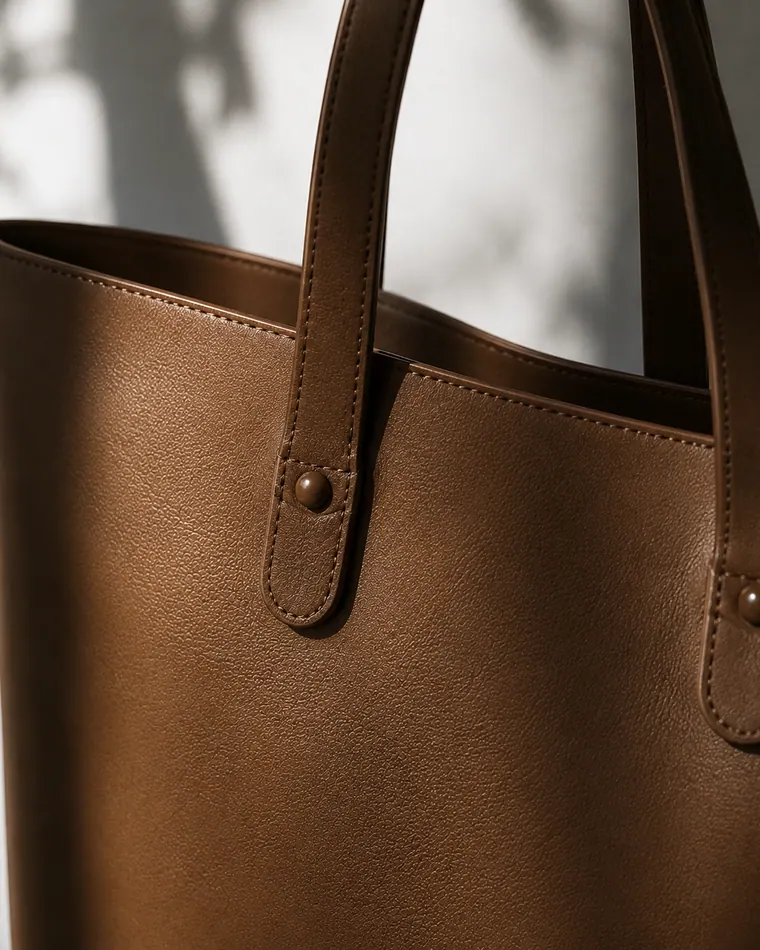
The visible material is rarely where a bag's cost is decided. Hardware is: zippers and pullers, buckles, D-rings, magnets, feet, rivets and plates. Off-the-shelf hardware is cheap and available; anything shaped or branded needs its own tool, and a custom plate or puller carries its own minimum, its own plating specification and its own lead time — usually the longest one in the whole build. A single branded closure can therefore decide when cutting starts.
Material behaves differently from cloth too. Leather is sold by the hide, and a hide is an irregular shape with grade variation across it, so the cost driver is yield: how many panels of your pattern come out of an average skin, and how much has to be rejected for scarring or looseness. That is why two bags in the same leather at the same size can quote differently, and why moving a pattern by a centimetre sometimes moves the price. Coated fabrics and recycled synthetics remove the yield problem and introduce their own — roll width, coating adhesion and abrasion behaviour.
Structure is the third thing. A bag holds its shape because of stiffeners, edge finishing, reinforcement at stress points and the way the lining is built, none of which a flat drawing shows. Heavy material also needs specific machinery — post-bed and cylinder-arm machines, edge painting, skiving — so a factory that sews apparel beautifully may be the wrong supplier entirely. Sampling in this category is where structure gets solved: the first mock-up is often made in a substitute material simply to prove the shape before the real leather is cut.
Finally, the tests that matter are mechanical rather than cosmetic. Zipper cycles, handle and strap pull, hardware finish under abrasion and the behaviour of a loaded bag over time are what a customer experiences as quality — and they are the failures that generate returns long after an inspection passed on appearance.
For brands whose product has to survive being carried
Situations we see here often, not an exhaustive list.
- Importers moving from stock designs to their own patterns and hardware
- Retailers building private label bags alongside branded stock
- Apparel and lifestyle brands extending into accessories without an accessories supplier
- Tech and work-lifestyle brands sourcing sleeves, organisers and carry systems
- Ecommerce and DTC brands launching a first bag or small leather goods range
What Library of Trade helps with
The points this category asks for most often, not everything we do.
-
Hardware sourced separately
We treat hardware as its own sourcing job — stock components where they will do, tooled components where the design needs them — because hardware lead time is usually what sets the production start date, not the sewing.
-
Material chosen on yield
Leather, coated fabric, recycled synthetics and canvas are compared on how they cost out in your actual pattern, not on price per unit of material. Panel layout is part of the costing conversation rather than an afterthought.
-
Factories matched by machinery
Bag factories are specialised by construction: soft unstructured totes, structured leather goods, technical packs and small leather goods are largely different plants. We match to the build and to the finishing capability it needs.
-
Structure solved in sampling
Product development covers panel patterns, stiffener and reinforcement specification and hardware placement, so sample rounds resolve real questions instead of rediscovering the shape each time.
-
Mechanical testing, not just appearance
Quality plans include the failures customers actually meet — zipper cycling, strap and handle pull, hardware finish, colour match across panels. Our note on reducing supplier quality risk covers the approach.
-
Freight priced on volume
Bags ship as shape rather than weight, so cartonisation and container fill are modelled with the quote. That is often the difference between the landed cost you expected and the one you get.
How Library of Trade sources this category
-
01
Brief
Bag type and construction, capacity and what it has to carry, material direction, quantity per colourway, target cost and the season or launch it belongs to.
-
02
Product Development
Panel patterns and the three-dimensional shape, stiffener and reinforcement specification, hardware type and placement, lining architecture and how branding is applied.
-
03
Materials
Leather grade and finish or coated fabric and backing, lining, webbing, threads, zippers, and every piece of hardware with its plating specification and minimum.
-
04
Factory Matching
Matching factories on machinery for heavy material — post-bed sewing, skiving, edge finishing — plus hardware sourcing ability, tooling access, minimums and audit status.
-
05
Sampling
Often a mock-up in a substitute material to prove the shape, then a sample in the real material with real hardware, then a confirmation sample once the tooled parts arrive.
-
06
Production
Hardware and material both have to land before cutting; production then runs cutting, skiving, preparation, assembly, edge finishing and hardware fitting.
-
07
Quality
Stitch density and straightness, zipper and closure cycling, handle and strap pull, hardware plating and finish, colour and grain consistency across panels, dimensional check.
-
08
Logistics
Volumetric weight rather than mass drives the freight cost, so packing method, nesting and container fill are decided with the shipment, alongside origin and duty treatment.
Materials, processes and supplier types
A selection of what comes up in this category, not a complete list. If your material, process or supplier type is not here, name it in your brief.
Materials
- Full-grain and split leather
- Vegetable-tanned and chrome-free leather
- Recycled polyester and RPET fabrics
- PU and coated fabrics
- Cotton canvas and waxed canvas
- Nylon and ballistic weaves
- Webbing, binding and threads
- Stiffeners, foams and linings
Processes
- Pattern making and panel layout
- Clicker and die cutting
- Skiving and edge painting
- Post-bed and cylinder-arm sewing
- Riveting and hardware setting
- Embossing and debossing
- Screen printing and heat transfer
- Metal plating and finishing
Supplier types
- Structured leather goods factory
- Soft bag and tote factory
- Technical pack and luggage plant
- Small leather goods workshop
- Tannery and leather agent
- Hardware and zipper supplier
- Webbing and trim supplier
- Third-party inspection partner
Quality, compliance and risk
The checks that apply here most often. What your product needs is decided per project.
Bags fail mechanically and they fail late. A seam that looks perfect can pull at the strap anchor after a month of loaded use; a zipper that runs smoothly on the sample can bind after a few thousand cycles; plating can dull or lift where a hand rests. So the quality plan has to name the tests, not just the appearance: pull strength at the stress points, closure cycling, abrasion on the finish, and a loaded-use check rather than an empty bag on a table.
Consistency is the second theme. Leather varies by hide and by lot, so grain and shade across panels of the same bag — and across a production run — is a decision to be specified, not a property to be hoped for. Hardware from a different batch can plate to a slightly different tone, which is visible when two components sit next to each other.
On compliance, bags are consumer goods and sit under the EU's general product-safety framework, with REACH restricting certain chemicals in materials and coatings; leather and coated fabrics are the parts where that usually matters. Any specific claim — recycled content, a leather origin story, a tanning method — needs evidence behind it, and the schemes that certify such claims are voluntary ones a supplier chooses. What applies to a specific product should be assessed for that product.
- Pull and load testing at handles, straps and anchor points, on a bag loaded as it will be used
- Zipper, buckle and magnet cycling to an agreed number of operations
- Hardware plating specified, then checked for tone and adhesion across batches
- Grain and shade consistency agreed across panels and across the production run
- Edge finishing and stitch density inspected against the approved sample
- Restricted-substance expectations agreed with the tannery or fabric supplier, not only the factory
- Cartons and packing drop-tested, since a crushed bag arrives as a damaged bag
Sourcing regions
Regions that often come into play for this category. Not a ranking and not a complete list.
-
China
The widest ecosystem for this category by a distance: coated fabrics, hardware, plating, tooling and assembly all within reach of one another, which shortens the loop when a design needs a custom closure. It is usually the most capable route for hardware-heavy or structured designs, and the most flexible on tooling cost.
-
Vietnam
Strong in bags, packs and luggage with large, well-run plants and a compliance culture European buyers tend to find straightforward. Hardware and technical fabrics are often imported, so component lead time and origin both need to be checked rather than assumed.
-
India
A long leather-goods tradition with real hand-finishing skill and competitive costs on labour-intensive constructions. Hide grade and lot-to-lot consistency need tighter specification and inspection than a synthetic programme would, which is a management cost as much as a quality one.
-
Turkey
Leather goods and coated-fabric bags with short transit into Europe, which makes mid-season repeats and smaller batches realistic. Costs sit between Asia and Western Europe, and the proximity is worth most to a brand that reorders rather than one that drops once.
-
Portugal and Spain
Small-run leather goods with high finishing standards and the shortest lead times into European markets. Unit cost is high and minimums are low, which suits a first collection, a premium positioning, or a style being proven before it is scaled elsewhere.
Questions about this category
Why is custom hardware so much slower than the bag itself?
A shaped or branded component needs a tool made, samples plated and approved, then a production run of its own before assembly can start. The tooling and approval loop, not the machining, is what takes the calendar time — which is why hardware decisions belong at the start of a project rather than after the sample is liked.
Leather or a recycled synthetic — which is cheaper?
It depends on your pattern more than on the material price. Leather cost is driven by yield from an irregular hide, so a panel-heavy design can be expensive in leather and modest in a roll good. A coated or recycled fabric removes the yield question and shifts attention to abrasion, coating adhesion and how the material ages.
Can the factory that makes our clothing make our bags?
Usually not well. Heavy material needs post-bed or cylinder-arm machines, skiving and edge finishing, and structured bags need a plant that builds shape rather than drape. A garment factory will often agree to try, and the result normally shows in the stress points.
How do we stop the leather looking different from bag to bag?
By treating grain and shade as a specification: an approved standard, an agreed acceptable range, panel-matching rules for the visible faces, and inspection against that range rather than against the best bag in the batch. Natural material varies; what is controllable is how much variation ships.
What does a bag sample process normally look like?
Frequently a first mock-up in a cheaper substitute material to settle proportions and structure, then a sample in the real material with the intended hardware, then a confirmation sample once tooled components exist. Each stage answers a different question, which is why compressing them tends to cost a round rather than save one.
Why did our freight cost more than expected?
Bags are bulky relative to their weight, so freight is normally charged on volume. Carton size, how bags nest and whether handles are packed flat can change container fill significantly — which is why packing should be designed alongside the product rather than after it.
Related reading
Related industries
Bring us the brief. We'll build the chain.
Send the design, the material direction and the hardware you have in mind, and we will come back with the routes that can build it and what each one costs delivered.