Industry
Beauty & Personal Care
Every beauty SKU is at least two supply chains — the formulation and filling on one side, the bottle, closure and decoration on the other — plus a regulatory file that has to exist before the product can be sold. The documentation, not the manufacturing, is usually the long pole.
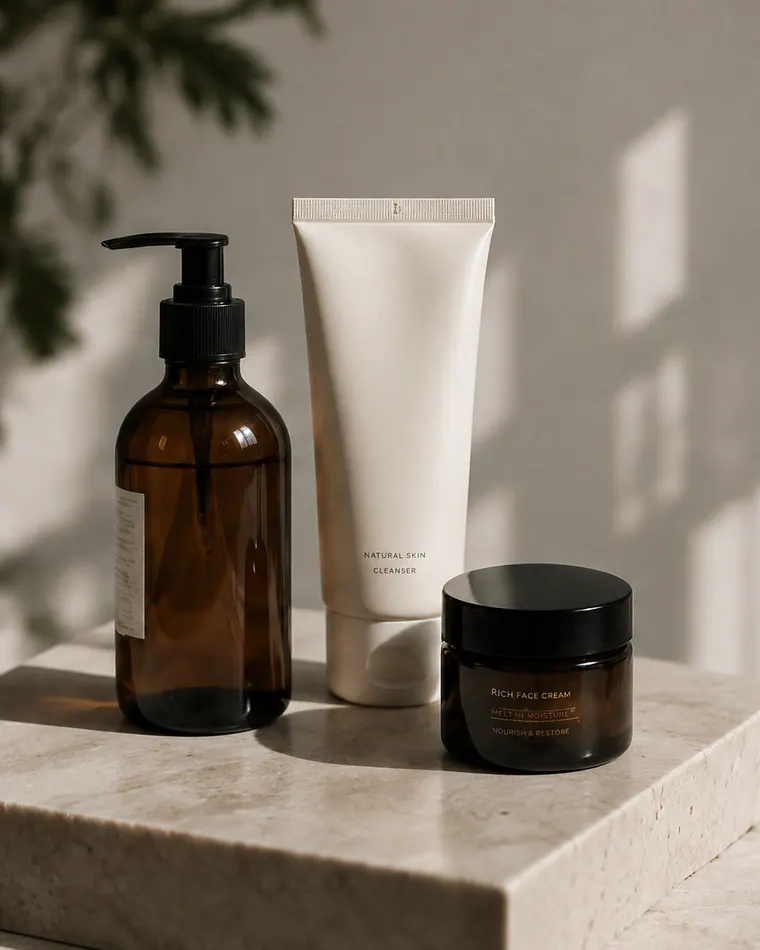
Two suppliers, one product, and a file that has to exist first
A single skincare SKU is bought from at least two independent supply chains that have nothing in common. One is the contract manufacturer that develops, mixes and fills the formulation; the other is the primary packaging — bottle or jar, closure, pump, and the decoration on it. Their minimums are set by different things and rarely align: the bulk minimum follows the size of the mixing vessel, while a component minimum follows a mould or a decoration setup. That is why a brand that can afford the cream frequently cannot afford the pack it wanted, and why both minimums have to be reconciled before a formulation is signed off.
The second thing that makes this category different is that time cannot be bought back. A formulation has to be tested for stability and for compatibility with the exact pack it will sit in, because a cream that is perfect in a laboratory jar can separate, discolour or interact with a pump over months on a shelf. That testing runs for real elapsed time, which is why a beauty launch calendar looks unreasonable to anyone used to hard goods. Compressing it does not make the product ready sooner; it moves the discovery of the problem to the customer.
Then the regulatory layer, which in the EU is substantial and specific. A cosmetic product placed on the EU market needs a designated Responsible Person established in the EU, a product information file including a safety assessment by a qualified assessor, and notification before it is sold; ingredient restrictions apply, allergen and ingredient labelling is prescribed, and marketing claims are themselves regulated. None of that is optional or quick, and it is specialist work — Library of Trade coordinates it and works with manufacturers experienced in it, but does not replace a safety assessor, and any formulation needs product-specific assessment.
Finally, the small things that decide whether the product feels finished: fill volume and its tolerance, closure torque, how a decoration survives a bathroom, shade consistency in anything coloured, and a preservative system that holds the product safe for its whole declared life. In beauty the last few per cent of the specification is most of the perceived quality.
For brands where the formulation and the pack have to arrive together
Situations we see here often, not an exhaustive list.
- Established brands reformulating, repackaging or moving away from an underperforming filler
- Brands with a formulation they own, looking for filling capacity and a packaging route
- Retailers and pharmacy chains building a private label skincare or bodycare line
- Salon, spa and professional brands taking a product retail
- DTC and ecommerce beauty brands developing their first own-formulation range
What Library of Trade helps with
The points this category asks for most often, not everything we do.
-
Formulation and pack sourced together
We source the contract manufacturer and the primary packaging as one project, so the bulk minimum and the component minimum are reconciled before a formulation is locked rather than after the sample has been approved.
-
Manufacturers matched by category
Emulsions, surfactant systems, anhydrous products and colour cosmetics are different manufacturing disciplines with different equipment. We match on the actual product type, on vessel size against your volume, and on documented regulatory experience.
-
Testing planned into the calendar
Stability and pack compatibility testing take elapsed time that cannot be shortened, so they are planned into the timeline from the beginning instead of being discovered as a delay.
-
Regulatory work coordinated
We coordinate the documentation route — safety assessment, product information file, Responsible Person, notification and labelling — with qualified specialists. This is coordination, not a substitute for a safety assessor.
-
Components and decoration managed
Bottles, jars, pumps, closures and their decoration are their own sourcing job with their own tooling and colour standards, and they are managed as such alongside our packaging capability.
-
Direct supplier relationships
You contract with the manufacturer and the component suppliers directly, own your formulation and specification, and keep suppliers you already work with. There is no sourcing fee charged to you as the buyer.
How Library of Trade sources this category
-
01
Brief
Product type and positioning, the claims the range needs to support, texture and sensory targets, pack format, quantity per SKU, target cost and the markets it will be sold in.
-
02
Product Development
Formulation development against a benchmark, pack architecture and fill volume, a compatibility and stability test plan, and the artwork and regulatory copy the label has to carry.
-
03
Materials
Actives and functional ingredients, the base system, the preservative system and fragrance — plus the primary packaging: resin or glass, closure or pump, and the decoration method.
-
04
Factory Matching
Matching a contract manufacturer on product category, vessel size against your batch, and documented regulatory experience — and separately matching the component suppliers and decorators.
-
05
Sampling
Laboratory bench samples, then a pilot batch, then formal stability and pack-compatibility testing in the real component, ending in a filled sample that is the approved standard.
-
06
Production
Bulk batch manufacture, filling and closing, decoration and labelling, batch coding and retained samples — with the components having to land complete before filling can be scheduled.
-
07
Quality
Fill weight and volume, pH and viscosity against specification, microbiological testing, closure torque and leak testing, decoration adhesion and position, and a full artwork and labelling check.
-
08
Logistics
Temperature exposure in transit matters to an emulsion, some formulations are restricted for air freight, and remaining shelf life on arrival is part of the plan rather than an afterthought.
Materials, processes and supplier types
A selection of what comes up in this category, not a complete list. If your material, process or supplier type is not here, name it in your brief.
Materials
- Emulsifier and base systems
- Plant oils, butters and waxes
- Humectants and functional actives
- Preservative systems
- Fragrance and essential oils
- PET, PP and PCR-content plastics
- Glass bottles and jars
- Pumps, droppers and airless closures
Processes
- Formulation and bench development
- Pilot and scale-up batching
- Hot and cold emulsification
- Homogenising and vacuum mixing
- Piston and volumetric filling
- Stability and compatibility testing
- Silk screen, hot foil and label decoration
- Batch coding and secondary packing
Supplier types
- Contract manufacturer (formulation and filling)
- Private label formulation house
- Primary packaging supplier
- Closure and pump manufacturer
- Decoration and labelling specialist
- Accredited testing laboratory
- Safety assessor and Responsible Person service
- Secondary packaging and kitting partner
Quality, compliance and risk
The checks that apply here most often. What your product needs is decided per project.
Quality here is split between what a laboratory measures and what a customer notices. The measurable side — fill weight, pH, viscosity, microbiological results, closure torque, leak integrity — is checked per batch against a specification, because a formulation is a process that drifts rather than an object that is copied. The noticed side is texture, scent on application, how a pump primes, whether a printed logo survives a wet hand, and shade consistency between batches. Both belong in the specification, and the second is usually left out.
Stability and compatibility deserve restating, because they are the most common cause of a recall-shaped problem in a young beauty brand. A formulation is only stable in a specific pack: a component can absorb, leach, discolour or fail to reseal, and a preservative system can be undermined by the packaging as easily as by the formula. A late component substitution therefore reopens the question rather than closing it.
On the regulatory side, the EU treats cosmetics as their own dedicated regime, and the obligations are real: a Responsible Person established in the EU, a product information file containing a safety assessment by a qualified assessor, notification before the product is placed on the market, prescribed ingredient and allergen labelling, restrictions on specific ingredients, and rules on the claims that can be made. Good manufacturing practice is the expected basis of manufacture. Voluntary schemes — organic and natural certifications, cruelty-free programmes, recycled-content claims — are chosen commercially and are not law. Requirements vary by product and formulation, so each product needs specialist assessment, and we will say plainly when something falls outside what we should be sourcing.
- Stability and pack-compatibility testing in the exact component the product will be sold in
- Fill weight, pH, viscosity and microbiological results verified per batch, not once at sample stage
- Closure torque and leak testing on the filled, decorated unit
- Batch coding and retained samples so any question can be traced back to a specific batch
- A product information file with a safety assessment by a qualified assessor, an EU-established Responsible Person, and notification completed before the product is placed on the market
- Ingredient, allergen and claim wording on artwork checked against the regime, not against a competitor's label
- Voluntary certifications treated as commercial choices with their own evidence requirements
Sourcing regions
Regions that often come into play for this category. Not a ranking and not a complete list.
-
Italy, Spain and France
The established European contract-manufacturing base for skincare and personal care, with regulatory fluency, short transit and the shortest documentation path for an EU launch. Unit costs are higher than Asia; the offset is less regulatory risk and faster reaction to a problem.
-
Poland and Central Europe
Growing filling and formulation capacity inside the EU at costs below Western Europe, often with lower minimums. A pragmatic middle for a brand that wants EU manufacture without the premium of the traditional clusters.
-
South Korea
The strongest formulation innovation in skincare, with fast development cycles, distinctive textures and a broad component ecosystem. The considerations are the longer route to a complete EU documentation package and transit on a temperature-sensitive product, both manageable but needing planning.
-
China
Primarily relevant here for primary packaging and decoration — bottles, jars, pumps, closures and finishing — where tooling costs and capability are hard to match. Component sourcing there can be combined with filling closer to the market, a common and sensible split.
-
Turkey
Cost-effective filling and personal care manufacture with short transit into Europe, useful for bodycare, haircare and bath ranges where volume is high and unit value is modest.
Questions about this category
What do we legally need before we can sell a cosmetic product in the EU?
At minimum a designated Responsible Person established in the EU, a product information file including a safety assessment carried out by a qualified assessor, notification before the product is placed on the market, and labelling that meets the prescribed requirements including ingredients and allergens. What applies in detail depends on the specific formulation, so it needs product-specific specialist assessment.
Why does a beauty launch take so much longer than a hard-goods launch?
Because part of the timeline is elapsed time rather than work. Stability and compatibility testing run in the real pack, and the safety assessment and notification depend on a finalised formulation and finalised components. You can run other work in parallel; you cannot make the testing shorter.
Which minimum will actually constrain us — the formula or the packaging?
Usually whichever component has tooling or a decoration setup behind it. Bulk minimums follow the mixing vessel; a custom bottle, a specific pump or a printed decoration follows a mould and a setup cost. Reconciling the two before the formulation is locked is what stops a late redesign.
Can we use our own formulation with a new manufacturer?
Often yes. The practical questions are whether the manufacturer has the right equipment, whether the raw materials are available to them at the same specification, and whether the formulation was documented well enough to transfer. Expect confirmation batches and fresh stability work in the new pack.
Do you source supplements, vitamins or anything ingestible?
No. Ingestible products carry approval, testing and liability regimes we do not claim capability in, so they sit outside what we source. Topical cosmetics and personal care are in scope; anything taken internally is not.
Can our formulation be certified organic or natural?
Those are voluntary certification schemes with their own standards for ingredients, percentages and documentation, chosen commercially rather than required by law. They are achievable, but they constrain the formulation, so the decision belongs at the development stage rather than after a formula is approved.
Related reading
Related industries


Bring us the brief. We'll build the chain.
Tell us the product, the pack format and the markets you want to sell in, and we will come back with the manufacturing and packaging routes and the documentation path.