Global sourcing, intelligently managed
Library of Trade manages global sourcing end to end, from materials and manufacturing to quality control and logistics. We combine human expertise, AI and a global network of vetted suppliers.
- Free to use.
- Up to 25% savings.
- Vetted suppliers.
The globe needs WebGL, which is unavailable here.
-
You send one brief.
Tell us what you want to make, how many, your target cost, quality and delivery needs.
-
We build the best supply chain.
AI and sourcing experts compare materials, pre-vetted factories and logistics to find the best fit.
-
You approve. We handle the rest.
From negotiation and samples to production, quality control and delivery, we manage it end to end.
-

Fashion & Apparel
-

Bags & Accessories
-

Jewelry
-

Packaging
-

Home & Living
-

Beauty & Personal Care
-

Pet Products
-

Baby & Kids
-

Kitchen & Dining
-

Travel Accessories
-

Sports & Outdoor
-

Promotional Products
Don't see your category? Schedule a call
Why Library of Trade
Global sourcing power for every business
-
Free to use

We're always free to use. Suppliers pay us an admin fee, so we only get paid when we save you money.
-
Save costs

Collective buying power unlocks better pricing across materials, production and freight.
-
Vetted suppliers

We build long-term partnerships with suppliers vetted for capability, quality and compliance.
-
Save time & effort

We manage the supply chain end to end, from idea to delivery, so your team doesn't have to.
-
Quality control

Approved samples and inspections keep production on spec and catch issues early.
-
Move faster

Go from idea to production in weeks, not months.
How it works
You set the brief. We manage the rest.
-
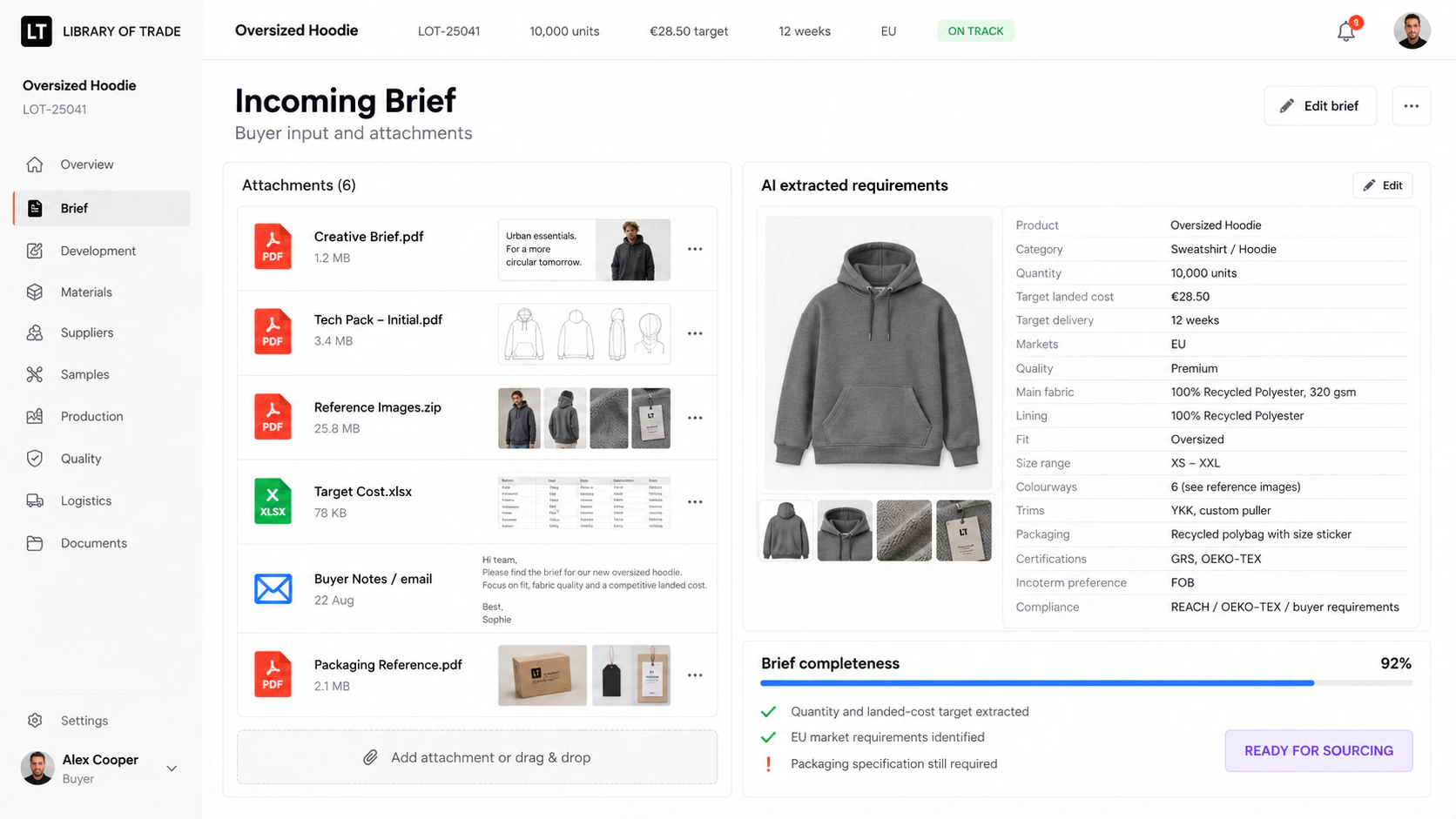
Define the product, volumes, target cost, quality, timeline and market requirements.
-
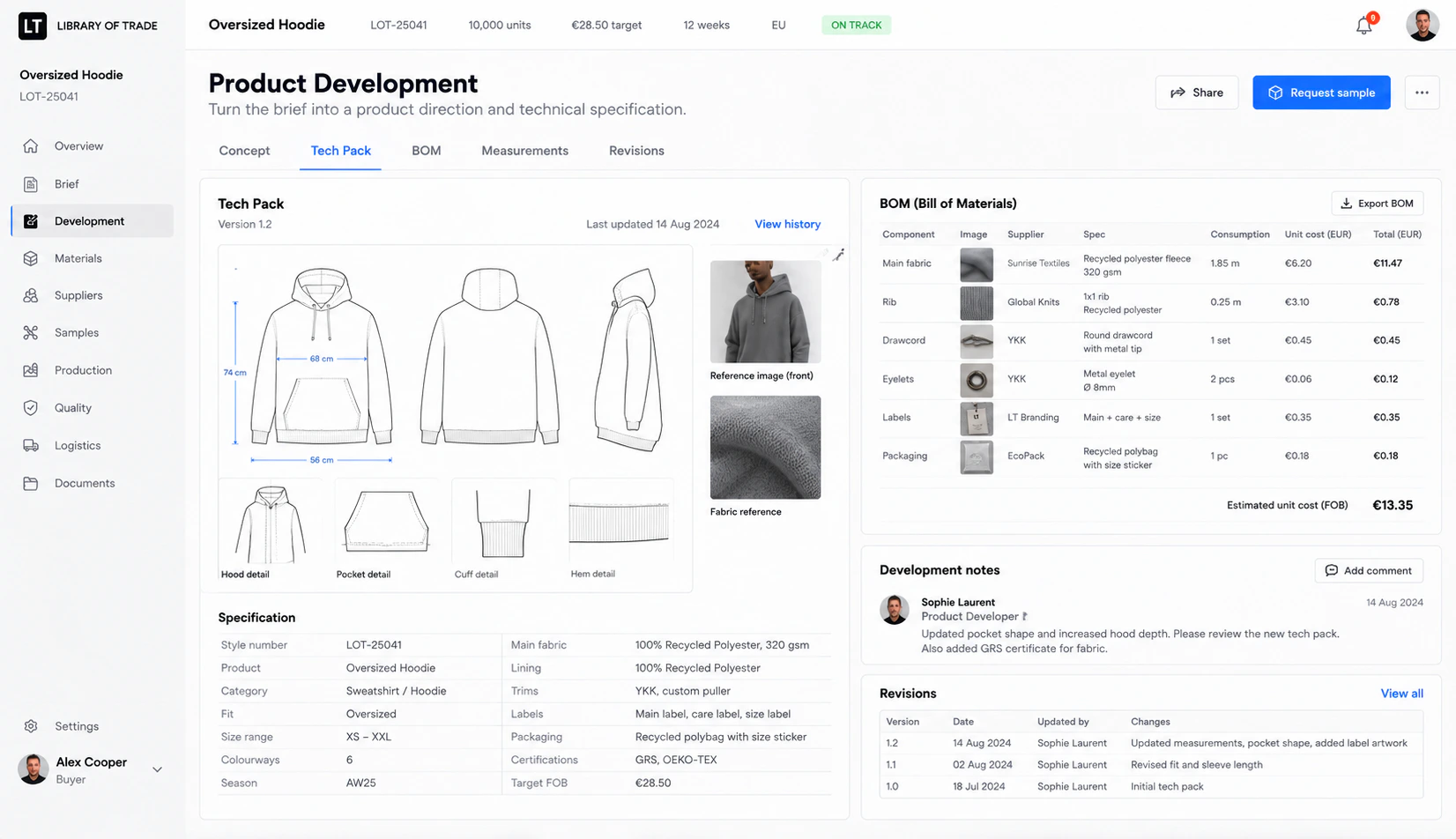
Turn the brief into specifications, tech packs, BOMs and a production-ready product definition.
-
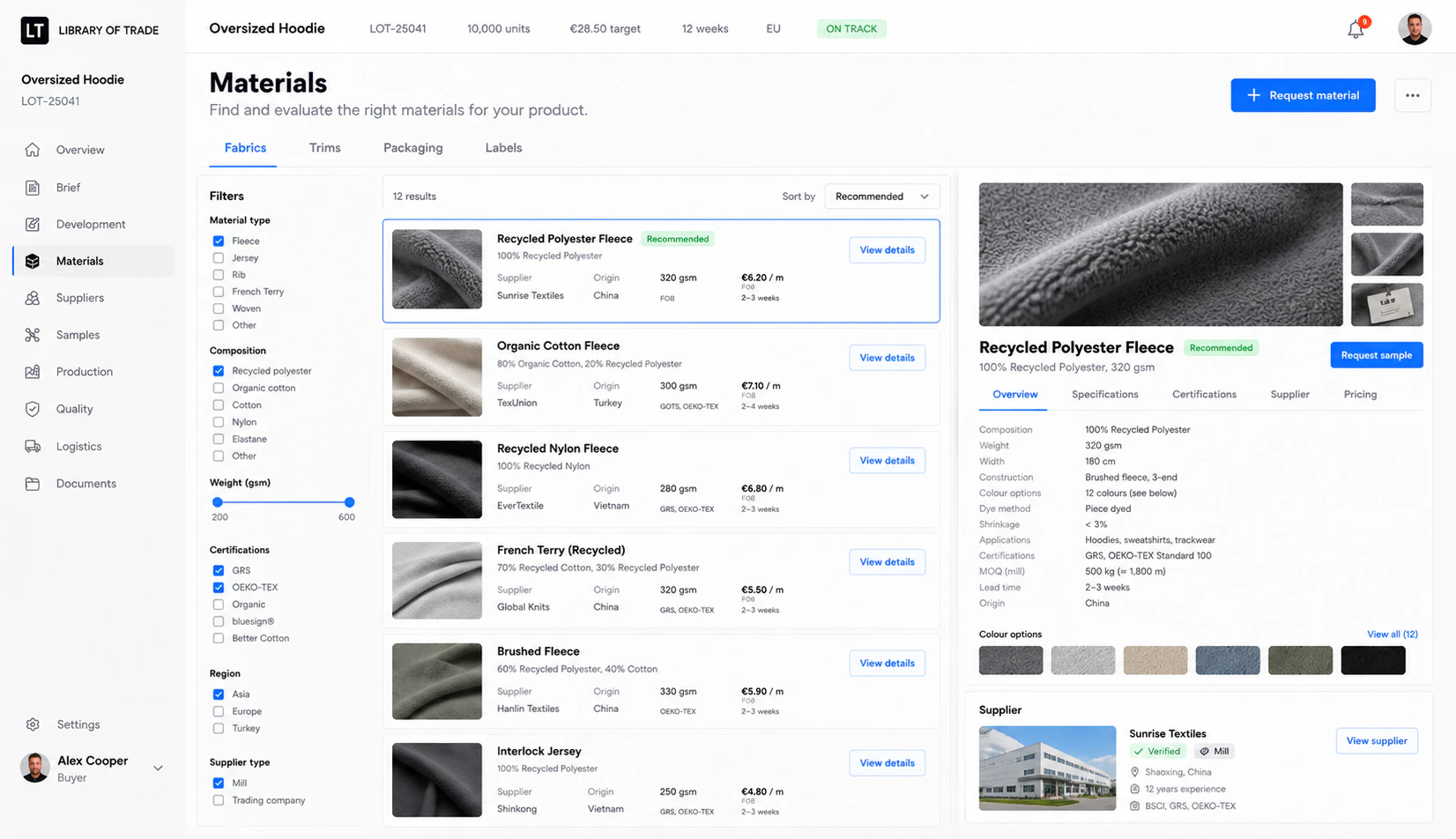
Source and optimize materials, components, trims and upstream suppliers.
-
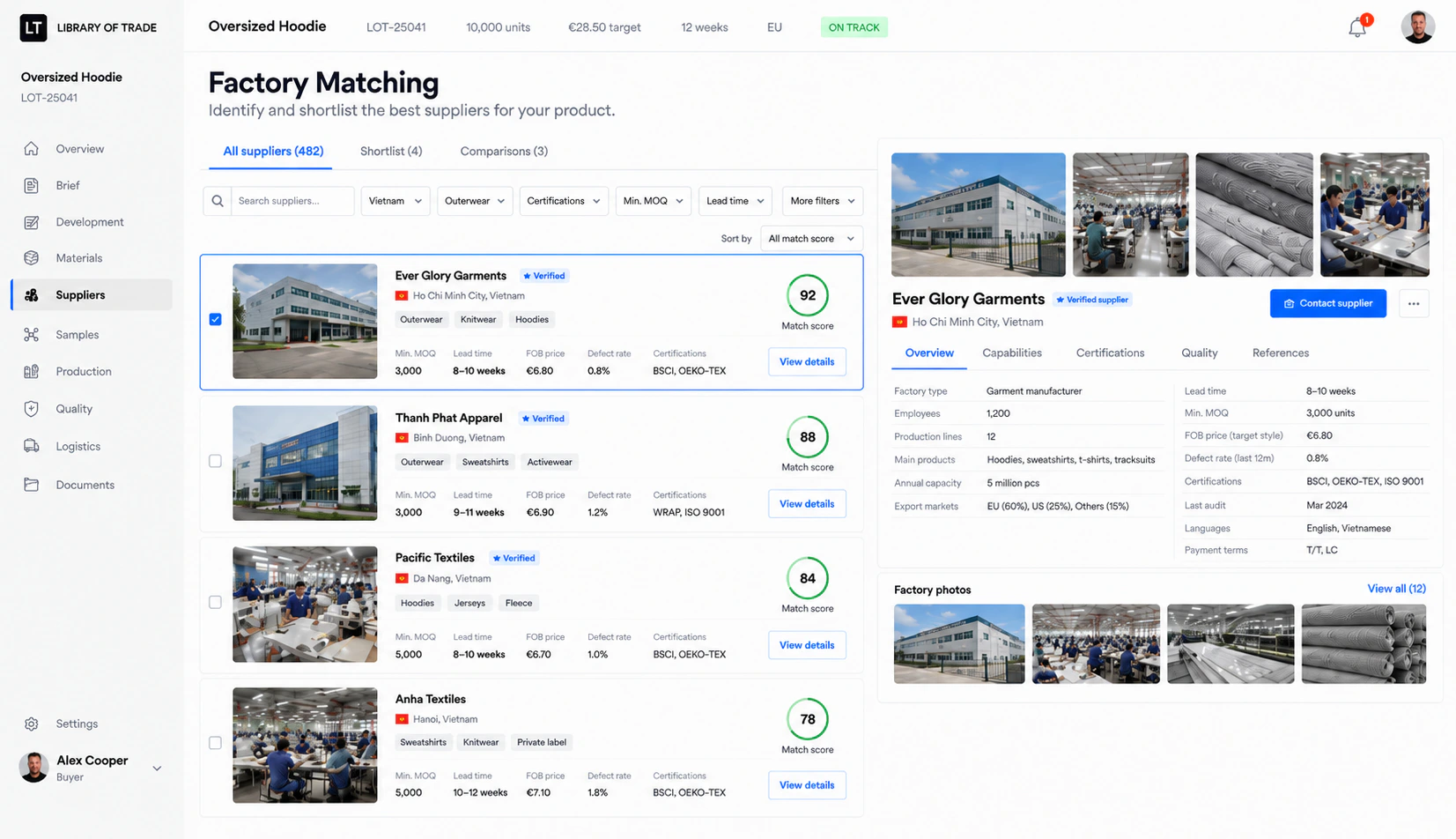
Match vetted factories on capability, price, capacity, quality and compliance.
-
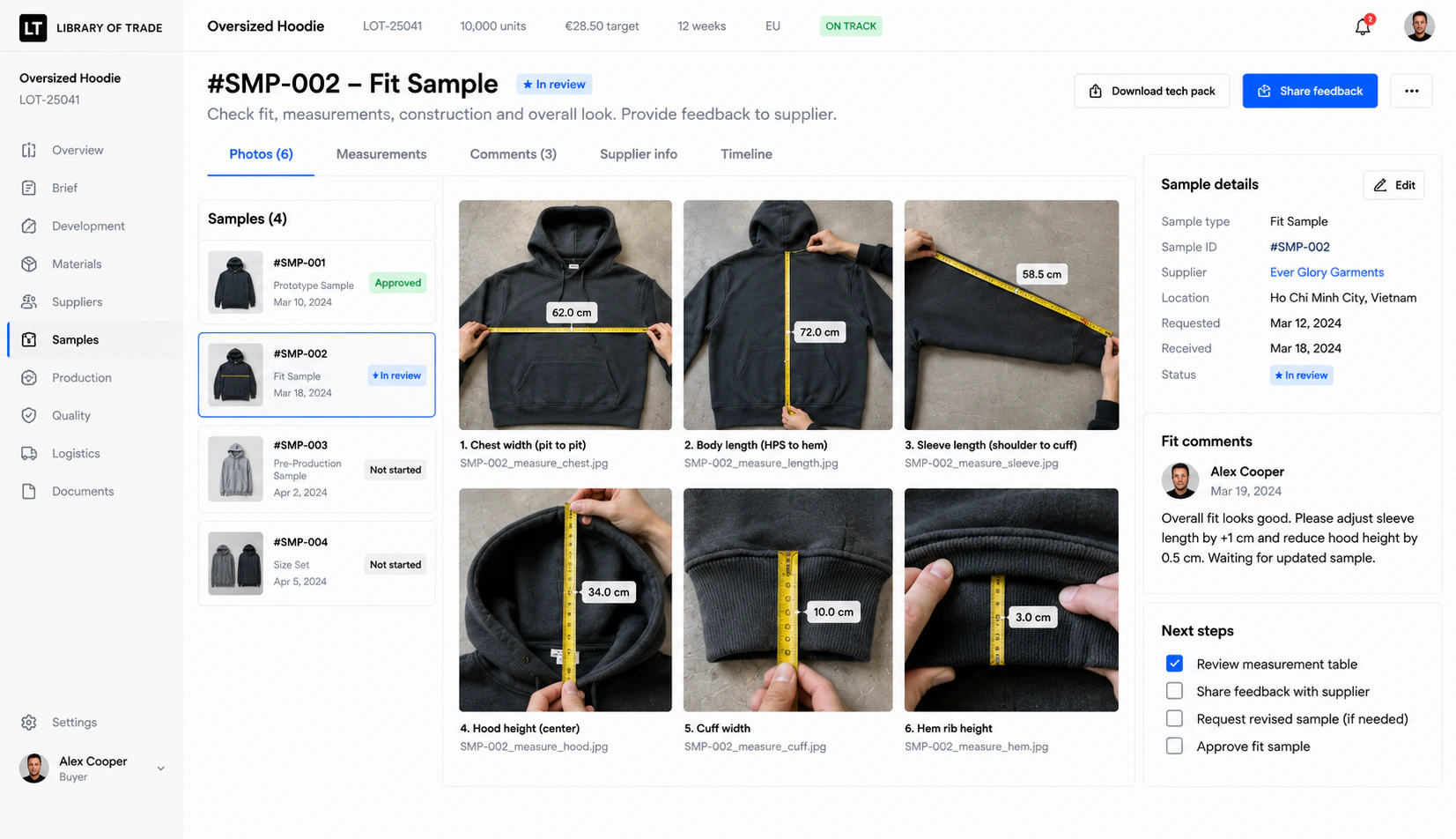
Develop, refine and test the physical sample before buyer approval.
-
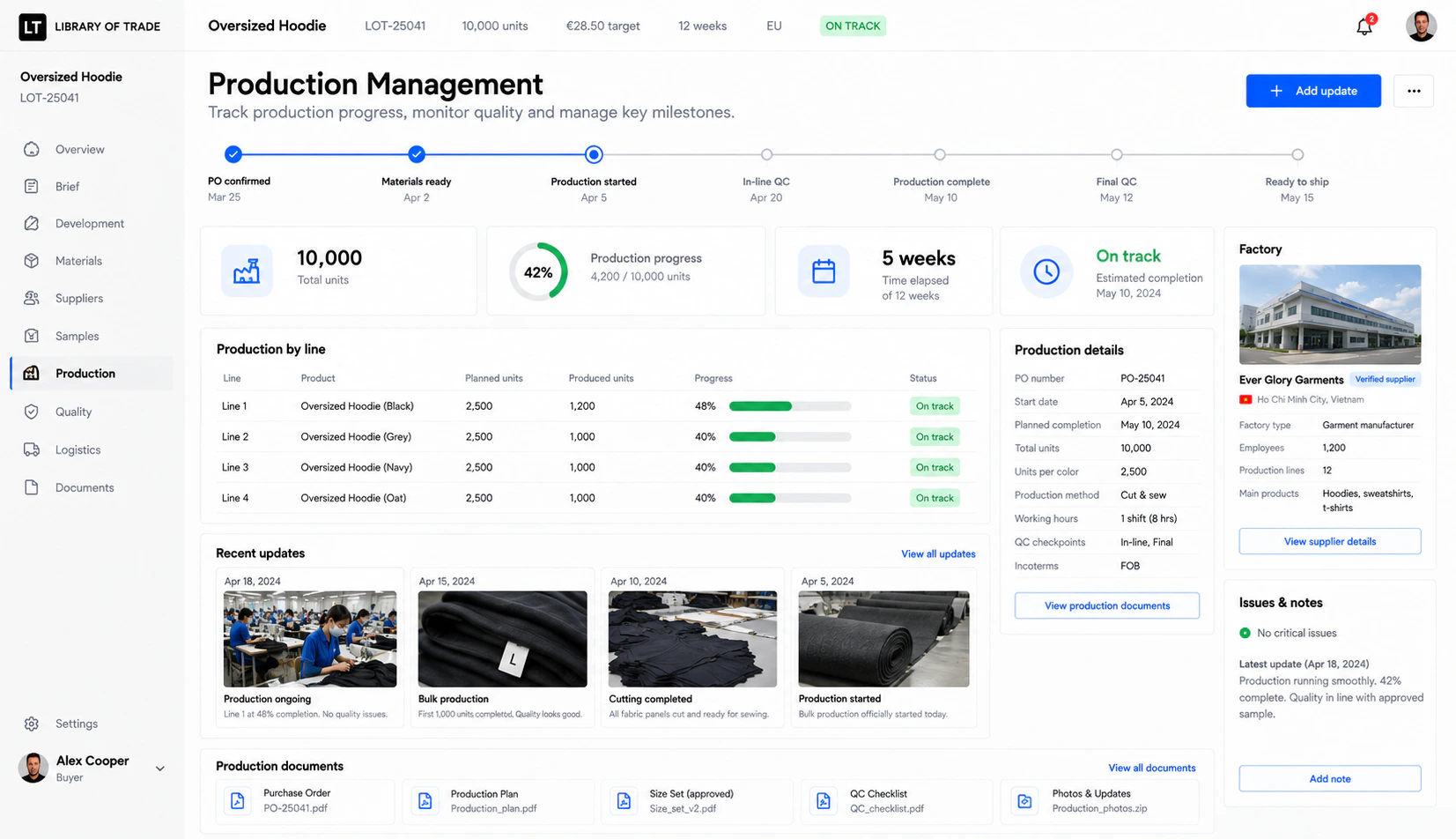
Manage capacity, materials, production milestones, output and exceptions.
-
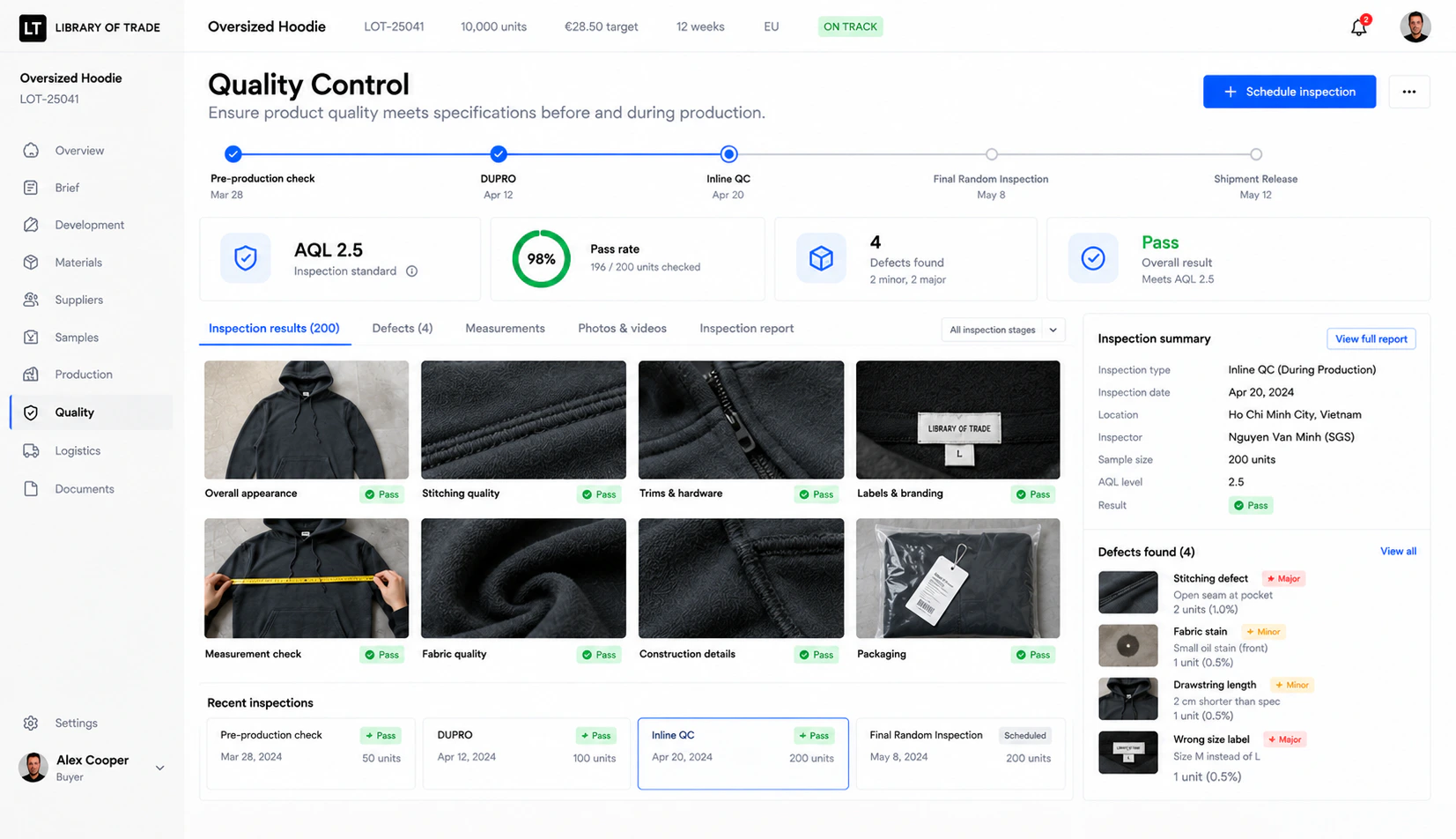
Inspect production against agreed specifications, tolerances and quality standards.
-
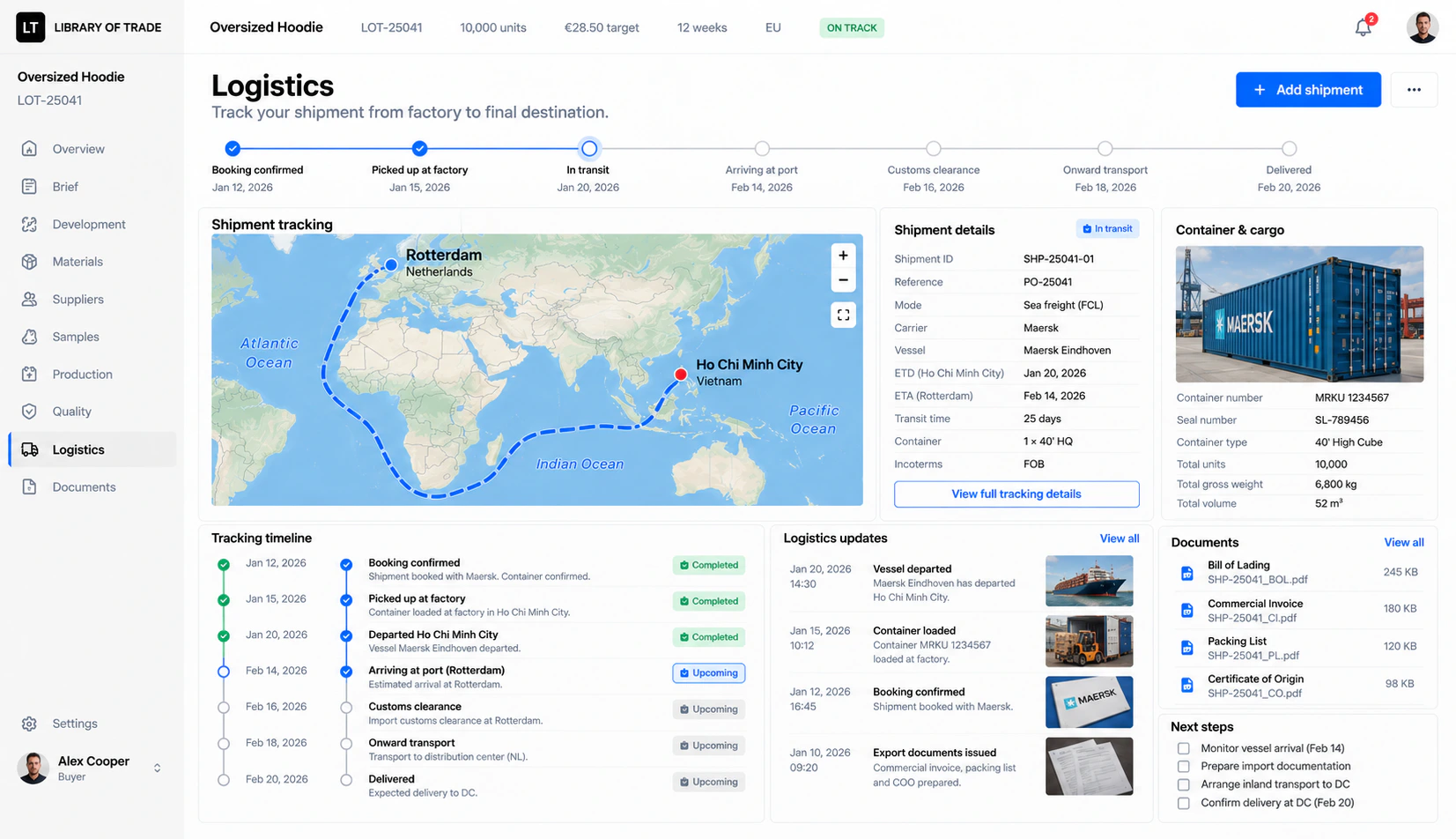
Manage freight, documentation, customs clearance and final delivery.





The best supply chain for every brief.
AI evaluates thousands of combinations of materials, pre-vetted factories, quality partners and logistics — finding the best balance of cost, speed and quality for your requirements. Human experts review and verify the final recommendation.
- The brief: 6,000 units of a heavyweight jersey T-shirt in 240 gsm combed cotton, four colourways. It fixes the specification, the quantity, the quality level and the delivery window, and its commercial priority is what the network has to optimize for. Nothing is sourced yet.
- The candidate network is compared against the objective — capability, capacity, price, lead time and product fit — reduced to a shortlist, negotiated, and confirmed by the people accountable for it before anything is selected.
- Candidate factories are compared for product capability, available capacity, lead time, compliance, cost, quality history and proximity to the selected materials.
- The selected materials travel to the selected factory, which assembles the order and then inspects it before it is released to freight.
- The finished order crosses from Asia to Europe.
- The order arrives, the import formalities are filed, and road freight moves it into the fulfilment network.
Combining AI and human judgment to orchestrate how the world makes and moves products — more efficiently and sustainably.
Demand, materials, production capacity and logistics still live in disconnected systems. Too often, the decisions that connect them are coordinated across spreadsheets, email chains, messaging apps and even fax. We are building the intelligence layer and global network that bring them together.
Read the manifestoExpert judgment, supercharged by AI.
AI gives our team the speed and scale to structure fragmented information, search a global network and compare thousands of possible supply chains. Our experts bring product judgment, supplier relationships and accountability. Library of Trade brings both together—from first brief to final delivery.
The diagram walks three new products through the same eight stages, each product using only the functions it needs. Each stage and the actions inside it:
- 01 Buyer brief intake — Input received, Requirements extracted, Requirements clarified
- 02 Product development — Design review, Technical development, Tech-pack revision, Manufacturability review
- 03 Materials selection — Material search, Material comparison, Specification review, Compliance check, Material selection
- 04 Factory matching — Supplier search, RFQ, Supplier questions, Quotes, Capacity checks, Cost comparison, Compliance checks, Shortlisting, Negotiation, Final factory selection
- 05 Sampling & fit — Sample request, Sample received, Measurements, Fit review, Fit comments, Revision, Sample approval
- 06 Order & production — PO / order management, Production planning, Cutting, Sewing, Finishing, Production updates, Exception monitoring
- 07 Quality & compliance — In-line QC, Final inspection, AQL review, Compliance verification, Shipment approval
- 08 Freight & delivery — Freight booking, Pickup, Export, Sea freight, Customs, Onward transport, Warehouse / DC, Delivery
- Case 01 — New development — technical shell jacket, 4,200 units, first production
- Case 02 — New development — 450 gsm organic-cotton hoodie, new fit block, 12,000 units
- Case 03 — New collection — six printed viscose dresses, e-commerce launch, nine-week window
- Integration — Connects customer, partner and logistics systems.
- Digital Library — Stores reusable product and material knowledge.
- Document Library — Controls files, versions and approvals.
- Search — Searches the vetted global supply network.
- Raw Materials — Coordinates material sourcing and availability.
- Materials Marketplace — Matches product requirements with suitable materials.
- Costing — Calculates product and landed-cost scenarios.
- Virtual Design — Develops and reviews products digitally.
- Compliance — Verifies requirements and partner compliance status.
- Sampling & Fitting — Manages samples, comments and approvals.
- Inspection — Records inline and final quality checks.
- Tracking — Monitors production and shipment progress.
- Order Management — Coordinates milestones across every order.
- Freight Management — Manages bookings, documentation and customs handoffs.
- Transport Management — Plans inland and multimodal movements.
- Warehouse Management — Coordinates inventory and fulfilment status.
- Finance — Tracks commercial status, payments and exposure.
- Collaborate — Connects conversations, decisions and responsibilities.
Frequently asked questions
Everything you need to know about sourcing with Library of Trade.
Is Library of Trade really free for buyers?
Yes.
Library of Trade is always free to use for buyers. There is no membership fee, subscription, or sourcing service fee.
We aggregate demand from multiple buyers and place that volume with suitable suppliers. This gives factories access to more combined volume through Library of Trade, allowing them to offer volume discounts and better commercial terms than an individual buyer could often achieve alone.
Suppliers pay Library of Trade an agreed administrative fee when a successful transaction is completed through our network. That fee is not added on top of your order value.
You contract directly with the supplier.
How does Library of Trade make money?
Library of Trade earns an agreed administrative fee from suppliers when a successful transaction is completed through our network.
The model works because we aggregate demand from multiple buyers. Instead of each brand purchasing a relatively small volume on its own, a supplier can receive larger combined volumes through Library of Trade. That enables the supplier to offer better pricing, volume discounts, and commercial terms.
The buyer benefits from the collective purchasing power, while the supplier pays Library of Trade for the transactions and qualified volume generated through the network. No separate sourcing fee is added on top of the buyer's order value.
How much can Library of Trade save me?
It depends on your starting point: current suppliers, materials, order volumes, manufacturing country, freight setup, duties and the rest of your landed cost.
Where there is meaningful optimization potential, we target a reduction in total landed cost of roughly 20%. Actual savings always depend on the product and where you start.
What makes Library of Trade different from a traditional sourcing agent?
Traditional sourcing models usually charge a fee or commission on top of your purchasing spend. Buyers pay us no sourcing service fee; suppliers pay an agreed administrative fee when a successful transaction is completed through our network.
Because we bring demand from several buyers, we can negotiate supplier agreements and collective pricing an individual brand may not be able to reach on its own.
That purchasing power then sits alongside sourcing expertise, supplier intelligence, AI, material optimization, quality management and logistics coordination. We do not just help find a factory. We help build a better supply chain.
How does Library of Trade make sure my designs stay mine?
Your designs remain yours.
We make this explicit in our agreements with suppliers: your designs, tech packs and specifications remain your property and cannot be used for other customers.
Where appropriate, we can also work with an NNN agreement or equivalent local protection.
Can a factory use my product or design for another customer?
No.
Our supplier agreements state that your proprietary designs and specifications may not be reused, copied or produced for other customers.
How does Library of Trade reduce my costs?
By optimizing the complete landed cost, not only the factory unit price. Savings can come from:
- collective purchasing power
- supplier negotiations
- material purchasing and material optimization
- better-fit factories
- the right manufacturing country
- freight consolidation
- logistics optimization
- duties and tariff considerations
What do I need to get started with Library of Trade?
Very little. A conversation can start from:
- a product idea
- reference images
- an existing product
- a physical sample
- a current supplier quote
- specifications
- a complete tech pack
We help structure whatever you have into what suppliers need for quoting, sampling and production.
Do I need a tech pack before I start?
No.
An idea, reference images, an existing sample or basic product requirements are enough to begin.
Where it is needed, we help turn that into the specifications and technical documentation suppliers quote and produce from. A complete tech pack helps; it is not required to start.
Can Library of Trade help develop a product from an idea or sample?
Yes.
Product development can start before sourcing does:
- product requirements
- specifications
- materials
- components and trims
- manufacturability
- technical documentation
- sampling and revisions
The point is to turn a concept into something that can be made reliably, at the right cost and quality.
How does Library of Trade select and verify suppliers?
We do not hand over factory lists. Suppliers are evaluated on:
- manufacturing capabilities
- relevant product experience
- production history
- quality performance
- certifications
- capacity
- reliability and communication
- audits and physical verification where appropriate
We look for the best manufacturing partner for the product, not the lowest quoted factory.
How does Library of Trade ensure product quality?
Quality starts before mass production. It is supported through:
- supplier capability evaluation
- sample development and approval
- specification control
- production monitoring
- during-production checks where required
- final inspections
- quality reporting
- supplier performance tracking
AI improves visibility and surfaces issues early; sourcing and quality experts make the judgment calls.
Can Library of Trade work alongside my existing suppliers?
Yes.
Most brands work with several suppliers rather than relying on one factory, and we can complement your existing base rather than replace it. Use us for:
- a new product
- a new category
- an additional manufacturing country
- an alternative supplier
- extra production capacity
- benchmarking existing pricing
- improving part of an existing supply chain
You decide where Library of Trade is involved.
Do I need to use Library of Trade for all of my products?
No.
We can source your entire range, or one single product or category — that is your call. There is no need to move your whole supply chain at once.
Start where it matters most, compare the result with your current setup, and expand only where it adds value.
Does Library of Trade have a minimum order quantity?
No fixed minimum.
We work with companies from early-stage brands to larger ecommerce businesses and retailers.
Individual factories and material suppliers do have their own MOQs, depending on the product, production process and materials. We look for the best-fit production setup for the situation — a supplier comfortable with a smaller first run, or a partner built for larger-scale production.
Does Library of Trade manage the full process through delivery?
Yes.
The complete sourcing journey can be coordinated end to end:
- 01 Brief
- 02 Product Development
- 03 Materials
- 04 Factory Matching
- 05 Sampling
- 06 Production
- 07 Quality
- 08 Logistics
Depending on what you need, we can manage all of it or work alongside your existing suppliers and logistics partners.
Bring us the brief. We'll build the chain.
Tell us what you need, when you need it and what matters most. We'll configure the route from materials to delivery.