Industry
Kitchen & Dining
Kitchen and dining products are heavy, breakable and in contact with food, which makes three things decisive: the material regime for food contact, the tooling behind every shape, and packaging engineered so the product survives the journey it has to make.
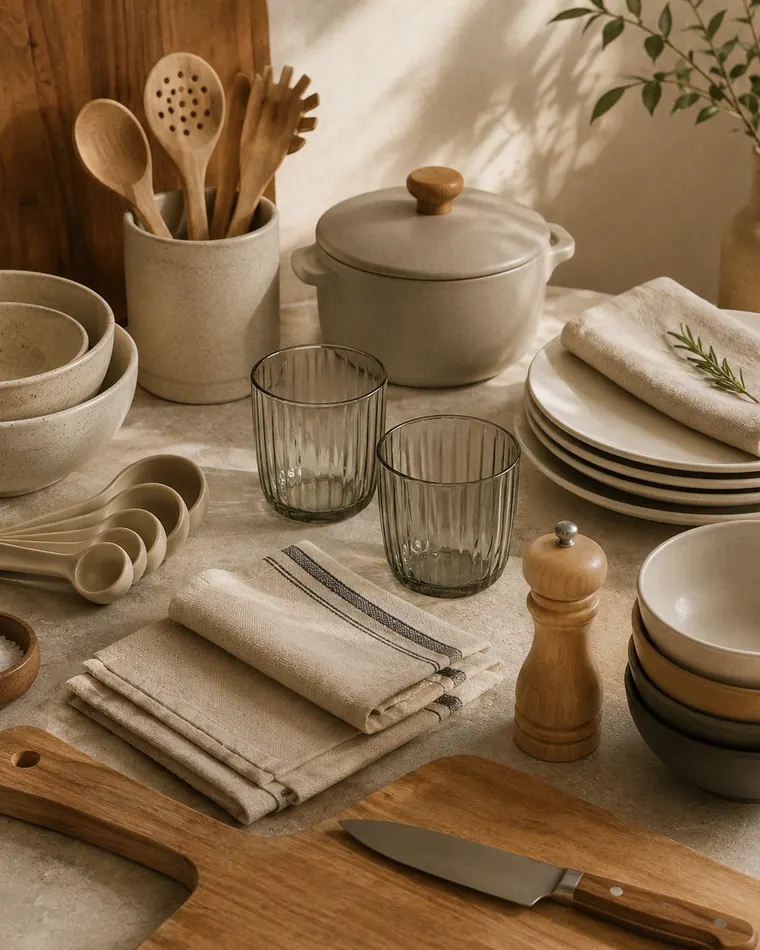
Food contact sets the rules, weight and breakage set the cost
The defining constraint is that these products touch food. Materials in contact with food have their own dedicated EU regime, with obligations that differ by material — a glaze, a stainless steel grade, a silicone, a plastic and a coated aluminium are each assessed against different requirements. In practice the supplier is expected to provide a declaration of compliance for the specific material and use, and testing evidence sits behind it. This is not the same conversation as general product safety, it is not satisfied by a supplier saying a material is "food grade", and it needs product-specific assessment.
The cost story is dominated by physics. A stoneware dinner set is heavy and fragile, so freight is paid on weight and on cube, and breakage is a cost line rather than an accident — the piece that arrives broken cost you the unit, its share of the container and the customer. That makes packaging a functional part of the product, not a wrapper for it, and it makes nesting and stacking a design decision with a direct freight consequence. A mug that stacks and a mug that does not can differ meaningfully in delivered cost.
Production adds variability that has to be planned for rather than eliminated. Ceramics are fired, and firing produces a range — glaze tone shifts, small surface flaws occur, and a normal loss rate is part of the economics rather than a supplier failure. Glass behaves similarly. So a shade is a band with limit samples at each end, kiln or furnace capacity constrains lead time in a way an assembly line does not, and second-quality sorting is part of the process. Every distinct shape also carries its own mould or die, which is why a range of many forms costs more to develop than a range of many sizes.
Then the performance claims, which are the quietest source of trouble. Dishwasher-safe, oven-safe, microwave-safe and induction-compatible are testable claims that need substantiating; thermal shock resistance is what makes or breaks that promise. And in cookware the failure point is almost always the handle attachment and the coating, not the body — a riveted handle that loosens or a non-stick surface that degrades is what a customer experiences as the product having failed.
For brands whose product goes in a dishwasher and an oven
Situations we see here often, not an exhaustive list.
- Importers moving from catalogue shapes to their own moulds and glazes
- Ecommerce and DTC tableware and homeware brands developing their own shapes
- Retailers and concept stores building private label kitchen ranges
- Cookware brands needing coating and handle engineering as well as manufacturing
- Hospitality and food brands sourcing branded tableware and serveware
What Library of Trade helps with
The points this category asks for most often, not everything we do.
-
Food contact treated properly
We specify the material for its intended use and obtain the supplier's declaration of compliance and supporting test evidence, rather than accepting a general assurance that a material is food safe.
-
Tooling and first articles managed
Every shape carries a mould or a die. We manage the tool, the first firing or first shot, and the acceptable variation range — plus who owns the tool, which is worth settling before it is paid for.
-
Suppliers matched by material
Potteries, glass works, cookware plants, moulders and metal stampers are separate industries. Matching to the right one — and to a factory with real food-contact documentation experience — does more than negotiating harder with the wrong one.
-
Variation handled with limit samples
Fired and cast products vary, so we agree limit samples at each end of the acceptable band and inspect against that range, which turns an argument about a normal piece into a measurable check.
-
Packaging engineered for transit
Cartons, dividers and pack configuration are designed and drop-tested on the packed unit, because on breakables the packaging decides how much of the order actually arrives sellable.
-
Freight modelled on cube
Stacking, nesting and pallet configuration are planned with the quote, since on heavy tableware the landed cost can look very different from the unit price.
How Library of Trade sources this category
-
01
Brief
The range and its shapes, materials and finish, capacity and dimensions, quantity per SKU, target retail price, the performance claims it must support, and the markets it is sold in.
-
02
Product Development
CAD and mould design, wall thickness and weight, stacking and nesting geometry, handle and lid attachment, capacity verification, and how the piece is decorated or marked.
-
03
Materials
Clay body and glaze, or glass type, or stainless grade, or silicone and coating system — chosen for food contact, for thermal behaviour and for the finish, with documentation in view.
-
04
Factory Matching
Matching potteries and kilns, glass works, cookware plants or moulders on capability, kiln or press capacity in your window, and a documented record with food-contact compliance.
-
05
Sampling
A first article from the tool, glaze or finish trials to fix the standard, then food-contact and performance testing — thermal shock, dishwasher cycles, capacity — on real production pieces.
-
06
Production
Forming, firing or forming and coating, with kiln loading and a normal loss allowance planned in, glaze batches controlled, and second-quality pieces sorted out rather than shipped.
-
07
Quality
Crazing, pinholes and glaze defects, dimensional and capacity tolerance, handle and rivet pull, thermal shock and dishwasher cycling, coating adhesion, plus a packed-unit drop test.
-
08
Logistics
Weight and breakage dominate: packaging is verified, cartons are palletised for stacking strength, and container fill is planned so the freight cost per sellable unit is what was modelled.
Materials, processes and supplier types
A selection of what comes up in this category, not a complete list. If your material, process or supplier type is not here, name it in your brief.
Materials
- Stoneware and porcelain clay bodies
- Lead-free and cadmium-free glazes
- Borosilicate and soda-lime glass
- Stainless steel (18/8 and 18/10)
- Cast iron and carbon steel
- Anodised and coated aluminium
- Food-contact-grade silicone
- Acacia, beech and bamboo
Processes
- Mould making and slip casting
- Jiggering and press moulding
- Glazing and kiln firing
- Glass blowing and pressing
- Metal stamping, spinning and deep drawing
- Non-stick coating application and curing
- Handle riveting and welding
- Decal, screen and pad decoration
Supplier types
- Pottery and ceramics works
- Glass works
- Cookware manufacturer
- Stainless steel fabricator
- Silicone and plastics moulder
- Wood and bamboo workshop
- Accredited food-contact testing laboratory
- Third-party inspection partner
Quality, compliance and risk
The checks that apply here most often. What your product needs is decided per project.
Two independent things have to be true here: the product must be safe in contact with food, and it must survive the use it claims to support. The first is documentary and testable — a declaration of compliance for the specific material and use, with migration and composition evidence behind it — and it differs by material, which is why a range spanning ceramic, glass, steel and silicone has several parallel compliance conversations rather than one. The second is physical: thermal shock, dishwasher cycling, coating adhesion, handle pull and capacity accuracy, tested on production pieces rather than asserted on a datasheet.
Then there is variation, which in fired and cast products is normal rather than defective. Glaze tone shifts between kiln loads, small surface characteristics occur, and a loss rate is part of the process. The workable approach is an approved reference plus limit samples marking both ends of the acceptable band, so inspection measures against a range and second-quality pieces are sorted before shipment rather than debated after it.
On the regulatory picture, be precise. Food-contact materials have their own dedicated EU regime, separate from general product safety, and specific materials carry specific requirements — ceramics, plastics and coatings are each treated on their own terms. Non-stick coatings and certain fluorinated chemistries are under active regulatory and buyer scrutiny, so the coating decision is a compliance decision as well as a performance one. Anything electrical, and anything marketed for children, is a different regime again and needs specialist assessment. What applies to a particular product should be assessed for that product.
- A declaration of compliance from the supplier for the specific food-contact material and its intended use
- Migration and composition test evidence held on file, per material rather than per range
- Thermal shock and dishwasher cycling tested on production pieces before a claim is printed
- Handle, rivet and lid attachment pull-tested on cookware and serveware
- Coating adhesion and durability verified, with the coating chemistry itself checked against current expectations
- Limit samples at both ends of the acceptable glaze or finish range, agreed before production
- Packed-unit drop testing and pallet stacking strength verified before the container is loaded
Sourcing regions
Regions that often come into play for this category. Not a ranking and not a complete list.
-
China
The deepest capability in the category by a wide margin — ceramics, glass, cookware, stainless and moulded goods with the lowest tooling costs, which matters when a range needs many distinct shapes. The trade-offs are sea transit, larger minimums and the need for genuine diligence on food-contact documentation.
-
Portugal
A serious stoneware and tableware base with strong EU documentation fluency, low minimums and short transit, which is often decisive for a small tabletop range that would be uneconomic to tool and ship from Asia. Unit costs are higher and the risk per decision is much lower.
-
Turkey
Substantial glassware and metal kitchenware capacity at costs between Asia and Western Europe, with transit into Europe measured in days. A strong option for drinkware and steel kitchen items that reorder frequently.
-
Vietnam
Growing ceramics and wooden kitchenware capability with competitive costs and a compliance culture European buyers find workable. Glaze and finish consistency is where specification and inspection need to be tight.
-
India
Competitive on stainless steel, brass and hand-finished serveware where labour content is high. Documentation and consistency need closer management, which is a planning cost rather than a reason to avoid the route.
Questions about this category
What do we need from a supplier to prove a product is food safe?
For materials in contact with food the normal expectation is a declaration of compliance covering the specific material and its intended use, supported by test evidence. Requirements differ by material, so a ceramic glaze, a plastic container and a coated pan each need their own documentation. A verbal assurance that something is "food grade" is not that documentation.
Why does the glaze colour vary between pieces?
Because ceramics are fired, and firing is a chemical process with a range rather than a fixed output. Kiln position, load and glaze batch all shift the result slightly. The controllable part is how much variation ships, which is why limit samples at both ends of the acceptable band are worth more than a tighter tolerance nobody can hold.
How do we reduce breakage in transit?
By treating packaging as part of the product. Carton grade, dividers, individual protection and pallet stacking strength all matter, and the only reliable way to know they work is to drop-test the packed unit and stack-test the pallet before the container is loaded rather than after the claims arrive.
Can we claim our tableware is dishwasher and oven safe?
Only if it has been tested to support it. Those are performance claims, and thermal shock resistance and repeated dishwasher cycling are what determine whether they hold. Printing the claim before the testing is done is the fastest route to a returns problem and a compliance one.
What is the minimum order for a custom ceramic shape?
It follows the tool rather than the category. Each distinct shape needs its own mould, so the practical minimum is set by what makes the tooling worth cutting, and a range of many shapes commits more than a range of many sizes of a few shapes. Reducing the number of distinct forms is usually the most effective lever.
Should we avoid non-stick coatings?
It is a genuine decision rather than an obvious one. Certain fluorinated chemistries used in non-stick coatings are under active regulatory and buyer scrutiny, and alternatives behave differently in use. The honest approach is to decide what performance the pan has to deliver, then choose the coating knowing both the compliance direction and the performance trade-off.
Related reading
Related industries


Bring us the brief. We'll build the chain.
Send the shapes, the materials and the quantities you are planning, and we will come back with the manufacturing routes, the food-contact documentation path and the delivered cost.